
THE CHINI TRUST’s Teacher Training Session
Understanding Neurodiversity: Creating Inclusive Classrooms

Date: 30 July 2026 (Thursday)
Mode: Online
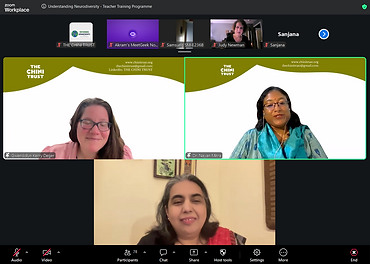
On 30 July 2026, The CHINI Trust conducted an online Teacher Training Programme on Understanding Neurodiversity, bringing together 120 educators from India, Nepal, the United Arab Emirates (UAE), the United Kingdom, and the United States. Designed exclusively for educators, the programme provided a valuable platform for teachers to deepen their understanding of neurodiversity while exploring practical, evidence-based strategies for creating more inclusive and responsive classrooms.
The programme commenced with a welcome address by Ms. Sohini Pramanick, Board Member of The CHINI Trust, who introduced participants to the Trust's vision of promoting inclusive education and supporting neurodivergent individuals through awareness, advocacy, educator training, and community initiatives. She also shared updates on the Trust's ongoing initiatives, including the Renu Dasgupta Memorial Prize, with nominations remaining open until 7 August 2026.
The session was led by Dr. Gwendolyn K. Deger, Assistant Professor of Special Education and Early Childhood Education at Penn State Abington, USA. Drawing upon both her professional expertise and lived experience as a neurodivergent educator, Dr. Deger introduced participants to the concept of neurodiversity as the natural variation in how individuals think, learn, communicate, and experience the world. She encouraged educators to move beyond deficit-based perspectives and recognise the unique strengths, abilities, and learning profiles of neurodivergent individuals.
Throughout the session, Dr. Deger explored key characteristics associated with ADHD, autism, dyslexia, dyscalculia, and other forms of neurodivergence. She explained concepts such as executive functioning, emotional regulation, sensory processing, working memory, time blindness, task paralysis, and rejection sensitivity through practical classroom examples, helping educators better understand the diverse experiences of their students.
A major focus of the programme was translating knowledge into practice. Dr. Deger shared practical, evidence-based strategies that educators can readily implement, including creating predictable classroom routines, using visual supports, breaking complex tasks into manageable steps, incorporating students' interests into learning, providing movement breaks, supporting executive functioning, and fostering emotionally safe learning environments. She also highlighted the importance of recognising individual strengths and adapting teaching practices to promote meaningful participation and belonging.
The interactive discussion and Q&A reflected participants' keen interest in implementing inclusive practices within diverse educational settings. Educators raised thoughtful questions on supporting neurodivergent learners with diverse needs, managing classroom behaviours with empathy, strengthening collaboration between educators and families, and adapting strategies for resource-constrained classrooms. The enthusiasm throughout the session led to numerous requests for a continuation programme focusing on additional activity-based approaches and practical classroom tools.
The programme concluded with a heartfelt Vote of Thanks by Ms. Meeta Sengupta, Board Member of The CHINI Trust, who expressed her sincere appreciation to Dr. Gwendolyn K. Deger for generously sharing her expertise and experiences. She also thanked all the participants for their active engagement, thoughtful discussions, and commitment to fostering inclusive educational practices.
The session reaffirmed that inclusive education begins with understanding, empathy, and responsive teaching. By combining scientific understanding with practical classroom strategies, the programme equipped educators with the knowledge and confidence to better support neurodivergent learners in their everyday practice.
The CHINI Trust extends its heartfelt gratitude to Dr. Gwendolyn K. Deger and to all the participants whose enthusiasm and engagement made the programme a meaningful and enriching learning experience. In response to the overwhelming interest and requests from participants, a follow-up session has been planned to continue exploring practical, activity-based approaches to supporting neurodivergent learners and strengthening inclusive classrooms. The Trust looks forward to continuing this shared journey towards building educational spaces where every learner is understood, valued, and empowered to thrive.
Actionable Keytakeaways
-
Understand before you respond - Behaviour is communication; look beyond the behaviour to understand the need.
-
Focus on strengths - Build on each learner's interests and abilities rather than focusing only on challenges.
-
Create predictable classrooms - Use routines, visual supports, and clear expectations to reduce anxiety and support learning.
-
Be flexible in your teaching - Adapt strategies, provide choices, and accommodate different learning styles.
-
Inclusion begins with empathy - Small, thoughtful changes can help every learner feel valued, supported, and included.
Feedback:
Manisha Das - "It was a great time, and I feel on cloud nine 😊. A new experience with new ideas for the way forward. Wishing you all the best, and I hope you all give us more time to understand how to build a great society."
Nighat Yasmeen - "It was an enlightening session on neurodiversity. It highlighted the importance of inclusion and gave me clear tools to adapt our teaching methods to meet diverse needs. Very relevant and impactful for today's time."
Saimul Tawqir - "Today's session was insightful, engaging, and highly relevant to classroom practice. Dr. Deger explained neurodiversity with clarity and provided practical strategies that I can immediately apply to create a more inclusive learning environment. Thank you for such a valuable learning experience."
Dr. Nasreen Bano - "A very insightful and engaging session. Thank you for sharing practical ideas that will help in the classroom."
Ishrat Hashim - "Thank you, Dr. Deger, for a thought-provoking session. I truly appreciate the practical ideas that I can implement in my classroom."
Dr.Rajanikant R Bhatt - "Thank you for your inspiring and insightful presentation on Neurodiversity. Your ability to explain such an important topic with clarity, empathy, and practical examples made the session truly engaging and thought-provoking.
Your message reminded us that every mind is unique, and that diversity in thinking is a strength to be celebrated rather than a difference to be judged. The knowledge and perspectives you shared will certainly help us create more inclusive and supportive environments.
Thank you once again for your time, dedication, and passion. Wishing you continued success in spreading awareness and inspiring positive change.
With sincere appreciation and gratitude."
Mila Sengupta - "Accepting students with divergent needs, being there to make them feel safe, be consistent, be patient and encouraging children to experiment to meet their individual needs would make us be mindful and better professionals as teachers."
Photos:
.png)
.png)
.png)