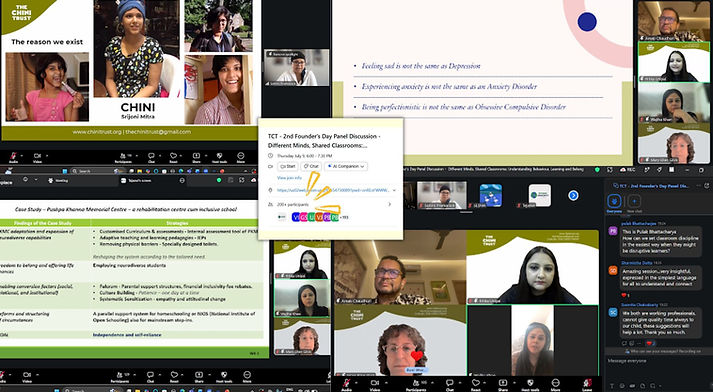
The CHINI Truts's 2nd Founder's Day Global Panel Discussion

Founder's Day 2026 | The CHINI Trust
Panel Discussion: Different Minds, Shared Classrooms: Understanding Behaviour, Learning, and Belonging
Date: 9 July 2026 (Thursday)
Time: 6:00 PM – 7:30 PM IST
Mode: Online (Zoom)
On 9 July 2026, The CHINI Trust commemorated its 2nd Founder's Day with a panel discussion titled Different Minds, Shared Classrooms: Understanding Behaviour, Learning, and Belonging. Bringing together over 200 educators, researchers, psychologists, parents, students, and inclusion advocates from India and abroad, the event created a meaningful space for dialogue on building classrooms where every learner is understood, valued, and supported.
The discussion reflected the Trust's continued commitment to advancing inclusive and ethical education by bringing together diverse voices from education, psychology, and community practice to explore how schools can move beyond awareness towards meaningful inclusion.
Opening Remarks
The session commenced with opening remarks by Dr. Nayan Mitra, Trustee of The CHINI Trust, who reflected on the Trust's journey over the past year and reaffirmed its commitment to creating a more inclusive society through education, mental health advocacy, sports, and community engagement.
Dr. Mitra shared several milestones from the Trust's work, including scholarships supporting children from grassroots communities, the continued growth of its internship programme, the expansion of inclusive football initiatives in collaboration with international coaches, and the publication of the Trust's second annual newsletter. She also announced that nominations remain open for the Renu Dasgupta Memorial Prize, recognising individuals making significant contributions to inclusive practices. Looking ahead, Trust announced an upcoming online teacher training programme on Understanding Neurodiversity, to be led by Dr. Gwendolyn K. Deger, Assistant Professor of Special Education and Early Childhood Education at Penn State Abington, USA. The programme reflects the Trust's commitment to equipping educators with practical knowledge and evidence-based strategies to build more inclusive classrooms.
Following the opening remarks, Ms. Sohini Pramanick, Board Member of The CHINI Trust, reflected on Chini's vision of a world rooted in empathy, dignity, and belonging. She spoke about how Chini's values continue to inspire the Trust's work and reminded participants that inclusion is not simply an educational objective, but a shared responsibility that extends across families, schools, and communities.
The panel discussion was preceded by an introduction from Tejaswi Rathod, Project Manager at The CHINI Trust, who welcomed the participants and introduced the moderator and panelists.
Panel Discussion
The discussion was thoughtfully moderated by Arnab Chaudhuri, who guided participants through three interconnected themes—from understanding the broader context of inclusion, to interpreting behaviour with greater sensitivity, and finally translating these ideas into practical classroom strategies.
Inclusion Begins with Systems and Mindsets
Opening the panel, Wajiha Khan, Educational Consultant and Teacher Trainer, reflected on the current realities of inclusive education in India. Drawing from over fifteen years of experience working with schools, educators, and communities, she emphasised that inclusion cannot remain confined to policy documents or isolated accommodations—it must become part of everyday classroom practice.
Through a compelling case study of an inclusive school in Kanpur, participants were introduced to practical examples of systemic inclusion, including curriculum adaptations, Individualised Education Plans (IEPs), accessible infrastructure, teacher preparation, financial support for families, and strong community engagement. The discussion reinforced that genuine inclusion requires sustained commitment from school leadership, teachers, families, and communities alike.
Understanding Behaviour with Compassion
Building upon this foundation, Dr. Ritika Uniyal, Faculty Member (Psychology) and Emotional Health Counsellor at Welham Girls' School, encouraged participants to reconsider the way behaviour is interpreted within educational settings.
She introduced the distinction between distress, disorder, and neurodivergence, highlighting that not every behavioural difference indicates a disorder. Instead, she encouraged educators to approach behaviour with curiosity rather than judgement, recognising that understanding the context behind a student's actions is often the first step towards meaningful support.
Dr. Uniyal also emphasised the importance of early identification, multidisciplinary collaboration, timely referrals, and normalising conversations around mental health. Her session reminded participants that emotionally safe classrooms begin with compassionate observation and informed responses.
From Behaviour to Belonging: Practical Classroom Strategies
Concluding the panel, Mary Ellen Glick, MSW, Case Manager at Penn State Abington, USA, translated these ideas into practical approaches that educators can readily implement through the framework of Functional Behaviour Assessment (FBA).
She explained that every behaviour serves a purpose and introduced participants to the four common functions of behaviour, escape, attention, sensory regulation, and access to tangibles. Rather than reacting immediately to challenging behaviours, educators were encouraged to gather information, understand the motivation behind the behaviour, and respond with appropriate support.
Mary Ellen shared several practical, low-cost strategies that teachers can adopt immediately, including creating visually organised classrooms, incorporating calming corners and sensory supports, using structured routines and visual schedules, providing movement breaks, and employing positive reinforcement strategies. Her presentation demonstrated that meaningful inclusion often begins with thoughtful classroom design and responsive teaching rather than expensive interventions.
Key Reflections
Across the discussion, several common themes emerged:
-
Inclusion requires systemic commitment rather than isolated accommodations.
-
Behaviour should be understood before it is managed.
-
Strong partnerships between educators, families, and students are essential.
-
Student voice and self-advocacy should be encouraged through collaborative planning.
-
Small, intentional classroom adjustments can significantly improve participation, learning, and belonging.
-
Inclusive education is built upon empathy, flexibility, and shared responsibility.
Participant Engagement
The panel witnessed enthusiastic participation, with over 200 participants joining from India and abroad. More than 50% of the participants were educators, reflecting the strong interest among teachers and education professionals in building more inclusive classrooms. The audience also included higher education faculty, researchers, psychologists, parents, NGO professionals, students, and inclusion advocates, making the discussion rich in diverse perspectives.
The interactive discussion and Q&A reflected participants' keen interest in practical classroom strategies, supporting neurodivergent learners, early identification, parent–teacher collaboration, and creating inclusive educational environments that recognise and celebrate learner diversity.
Conclusion
The discussion concluded with a shared understanding that inclusion is not achieved through isolated interventions, but through sustained commitment to transforming educational systems, classroom cultures, and everyday teaching practices.
While each panelist brought a distinct perspective, they collectively reinforced a powerful message: inclusive classrooms are created not by expecting learners to fit existing systems, but by designing systems that recognise, respect, and respond to the diversity of every learner.
The programme concluded with a heartfelt Vote of Thanks by Ms. Sohini Pramanick, Board Member of The CHINI Trust, who expressed her gratitude to the moderator, panelists, participants, Board Members, Advisors, interns, volunteers, and everyone whose contributions made the event possible. She reaffirmed the Trust's commitment to carrying forward Chini's vision by fostering conversations and initiatives that advance inclusive and ethical education.
The CHINI Trust extends its sincere appreciation to Arnab Chaudhuri for thoughtfully moderating the discussion; to Wajiha Khan, Dr. Ritika Uniyal, and Mary Ellen Glick for sharing their expertise and experiences so generously; to our Board Members and Advisors for their continued guidance; to our interns and volunteers for their dedication; and to every participant whose presence and engagement made this Founder's Day Panel Discussion a meaningful and enriching exchange of ideas.
As The CHINI Trust continues its journey, this conversation stands as another important step towards building educational spaces where different minds are not merely accommodated—they are welcomed, understood, and celebrated.
Visit us: www.chinitrust.org
Phostos: